![[JHG]](JHGlogo.png "Howard Gibson") AR‑15s and Liberty
AR‑15s and Liberty
AR‑15s and Liberty
AR‑15s and Liberty
The US gun community has determined that they need
AR‑15s,
known as sporting rifles
,
so that they can defend themselves from government tyranny.
Really?
Will a few fancy rifles really stop a government bent on tyranny?
Is armed force the best reaction to unwanted government activity?
This idea reflects America's historical tradition
of revolt against Great Britain.
Gun owners assume that they are the ones being tyrannized.
The American gun community has
strong libertarian
tendencies,TTAG
and a strong sense of victim-hood.
They assume all tyranny comes from the government.
The design of rifles, like the design of any other piece of machinery, is a set of compromises. The old bolt action battle rifles, used from the 1880s, through the two world wars, were expected to hit things anywhere up to 2800 yards away. See British Muzzleloaders below. By 1940, the Germans had worked out that infantry were not shooting at things more than 200 metres away. They designed the Sturmgewehr 44 around a smaller cartridgeterminology which allowed a smaller, lighter rifle, more cartridges in the magazine,mauser more magazines in the soldier's harness, and full, easily controlled automatic fire. These smaller, lighter rifles were christened assault rifles.
The important thing about the
AR‑15/M16/M4 series
rifles is their small cartridge, 5.56×45mm.
Compare this to the 7.62×63mm cartridge used on the older
M1 Garand.AK47
The M1 throws a bigger bullet a longer range.
The AR‑15 has a somewhat higher muzzle velocity,
but it does not hit the target as hard.
Gun guru
Col. Jeff Cooper
contemptuously described the M16 as a
poodle shooter
Cooper.
Is the AR‑15 an assault rifle? The rifle is light. It carries lots of ammunition. Most rifles available to civilians are semi-automatic, which means that it fires one shot for each trigger pull. Military rifles are fully automatic, which means that when you pull the trigger, it keeps firing until you stop pulling. Forgotten Weapons, a responsible gun channel on YouTube, says it is not...
Enough Nonsense; What is an "Assault Rifle"?
A proper assault rifle is fully automatic.
Perhaps,
if you are wearing a T‑shirt and jeans
and you are out on a gun range,
your semi‑auto is a sporting rifle
.
If you are dressed in camo
and wearing a harness with storage for extra magazines,
it is an assault rifle!
If you need to massacre the kids at your local school, the AR‑15 makes big enough holes. It provides you lots of cartridges in the magazine, lots of magazines in your pockets and pouch, and a rapid reload, Automatic fire actually is not all that useful. You don't need to pin the kids down, and there is limited need to shoot them multiple times.
Your neighbour's pit bull, Muffin
Few of them end well.
Probably, when you arm yourself and dare the authorities to try something, they will just shoot you. Perhaps one of those hyper-militarized police forces in the USA will get the address wrong and assault your neighbour's house, and shoot their pit bull, Muffin. The faster your revolt is put down, the better it is for just about everyone. If you win your first battle with the police, the fight will continue. The mechanics of guerrilla warfare are complex. Your local bandits make excellent guerrillas, but they still are rotten people. When the authorities finally win, there will be lots of carnage, much of it collateral. The authorities ought to decide they need to win hearts and minds. The sort of authoritarian types who get revolted against, assume they weren't being tough enough, and they get tough against people who had nothing to do with the revolt.
If the government collapses, there is no particular reason why you will be able to take power and set up an administration. There tends to be more than one revolutionary leader who thinks he should be in control. Some revolutionary leaders are devoted to whatever cause is being revolted about. Some revolutionary leaders are fanatics, determined to exterminate anyone who disagrees even with minor aspects of their ideology. Other revolutionary leaders are adventurers, dedicated to gathering power to themselves, and to personal fame and glory. The chaos you started often suits foreign powersRoses. Maybe they want your country ruled by someone they like. Perhaps your state of anarchy is seen as a good thing.
When you revolt against the authorities, you must accomplish three things...
The American Revolutionary War was an outlier, in that the victors set up a functional state. Great Britain was not very tyrannical. It was also not the mighty superpower it is described as in some current accounts of the revolution. The British had a powerful navy, and an army that was small compared to those of continental European powers.
This makes sense.
Great Britain is a group of islands.
Anyone who wants to conquer Great Britain
must get past the Royal Navy.
The navy got the bulk of the money for war.
The navy recruited, trained and promoted professional officers.
The English remembered the
New Model Army,
which
seized power in 1648.
A well drilled, efficient professional army was a threat to
parliament
and to the
king,
as well as to ordinary people,
and the
Irish.
With the
restoration of the monarchy,
the British army was kept under the command of people
who were politically reliable —
members of the royal family,
or high nobility.
A lot of the
weirder traditions
of the British army reflect this.
When American colonists described standing armies as tyranny,
King George III
understood them far better than we do.
The battles of
Blenheim
and
Waterloo
were not British victories.
They were allied victories under British generals,
with lots of help from continental generals like
Prince Eugene of Savoy
and
Gebhard Leberecht von Blucher.
A century later,
Otto von Bismarck
is supposed to have declared that if a British Army landed in Europe,
I'd get the Belgian police to arrest them.
Existential threats to Great Britain came from continental Europe. The British did not want to take troops away from this. There was some sympathy for the colonists' cause, and a reluctance to be at war with English speaking peoples. In the late eighteenth century, Britain's most valuable colony in the New World was Jamaica.
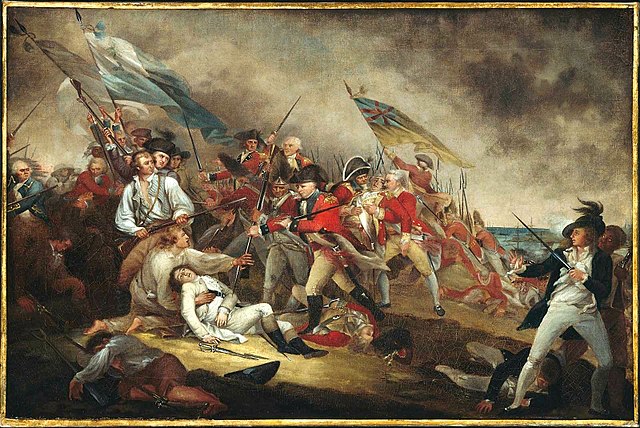
The painting above, by John Trumbull, is fascinating. This shows General Warren in white, slowly dying. The guy in the very centre of the picture is John Small, a British officer. He is shown deflecting a British bayonet aimed at Warren. Warren had only just been awarded a general's commission, and he fought at Bunker Hill as a private. He was killed instantly by a bullet to the head. The incident shown did not happen. Many American and British officers were old friends, and the war did not change this. This painting is an unusual piece of patriotic hagiography. You do not see portrayals of chivalry by the enemy from the French, Russian or the Chinese revolutions. Most revolutions are fought savagely.
At the war's end,
George Washington
was eager to surrender his general's commission
and return to his estates at Mount Vernon.
When he was called upon to serve as America's first president,
he did so, however,
he served his two terms and again he stepped down.
Washington was conscious that he was setting precedents
for how a President Of The United States of America should behave.
The state and the title were something greater than himself.
The USA required orderly transitions of power,
and it required capable new presidents to be ready to take over.
When told he was stepping down,
King George III
is supposed to have replied that
If he does that, he will be the greatest man in the
worldWash.
The French Revolution was brought about by a financial crisis. Kings Louis XIV and Louis XV waged wars all over Europe and the rest of the world, and ran a fantastic and expensive court at Versailles. The American Revolution was a glorious opportunity for Louis XVI to mess with Great Britain. By 1789, France was out of money, and Louis had to call up the Estates General for the first time since 1614.
We are not going to do a blow by blow description of the French Revolution. By continental European standards, the French people were not being oppressed. The three Louis' listed above, saw themselves as absolute monarchs, but they were not particularly tyrannical. The Estates General was an opportunity for all sorts of intellectuals to discuss enlightenment ideas of good governance, and the American Revolution provided them an example.
The intellectuals seized power. They beheaded Louis XVI, his queen Marie Antoinette, and all sorts of other aristocrats. They then turned on each other. Most of the leading figures in the French Revolution wound up in the Guillotine. Power was seized in a military coup by general Napoleon Bonaparte. Napoleon crowned himself emperor in 1804. The Napoleonic Wars killed somewhere between three and six million people, and in the end, the Bourbon monarchy was restored under Louis XVI's kid brother Louis XVIII. Much of Germany's later aggression was payback for the Napoleonic wars. The French Revolution was a disaster for everyone in the vicinity.
In the years since the American Revolution, many dozens of revolutions have taken place, almost all of which have failed.
In his book Holy Madness, author Adam Zamoyski documents revolutions starting with the American one, and ending with the Franco Prussian War. There was a class of professional revolutionaries who showed up where ever repression was suspected to be. The locals often were horrified, because they did not feel particularly oppressed, and they knew the authorities would over react.
In South America, Spain was decrepit, broken down by the Napoleonic wars, and unable to hold their colonies. South American broke down into small, badly administered dictatorships. According to Adam ZamoyskiHoly Madness they all were better governed by the original Spanish. Revolutions in nineteenth century Poland and Russia all failed. Revolutions in the Balkans against the Ottoman Empire eventually succeeded, leaving a pack of unstable, squabbling states who eventually triggered the First World War.
The Russian Revolution was tactically successful for the Bolsheviks. Their leader Vladimir Ilyich Lenin, grew up in an upwardly mobile family, and he was a successful student. He became a committed Marxist and he spent the next few decades writing articles, and organizing Marxist groups. Lenin was intolerant of people who disagreed with him, and an eager advocate of violence. As leader of the Soviet Union, he continued to not tolerate opposition, establishing the Cheka secret police to eliminate his enemies. He died in 1924, at the age of only 53. Joseph Stalin took over the party, the Soviet Union, and the secret police. You know the rest.
The ultimate failed revolution by an armed, prepared citizenry was the American Civil War. At the beginning, the federal government had a small professional army, some of which defected to the rebels. The southern states withdrew from the union, and called up their substantial militias, mostly equipped with up-to-date military rifles. The armies of the South won many stand-up, pitched battles. The North's superior resources prevailed in the end, and the total losses were at least 620,000 dead. Southerners like to depict the Civil War as a heroic Lost Cause. The primary states' right being fought over was slavery. Sometimes, the authorities are right.
At the end of the American Revolutionary War, George Washington resigned command of the Continental Army. After two terms as president, again he stepped down, to be succeeded by John Adams. It is unusual for revolutionary commanders to voluntarily hand over power to civilians, and for revolutionary leaders to retire. Having crowned himself emperor, Napoleon Bonaparte worked hard to integrate himself into Europe's monarchical system, ultimately marrying Marie Louise, an Austrian princess.
An important factor in the success of a revolution is the leader. George Washington did not divorce Martha and marry an Austrian princessNapoleon. At banquets, he did not get up on the tables and stomp about smashing plates and glassesBolivar. He did not arrest John Adams, Thomas Jefferson, James Madison, and James Munro, and execute them for treason. As the first great revolutionary, Washington provided his successors the opportunity to watch, to learn, and to improve on his performance. Nobody came remotely close. The later revolutionaries were adventurers, fanatics, egotists, and power junkies, not responsible leaders.
The American Founding Fathers feared tyranny. They understood that if one person collects too much power, they will be tempted to abuse it. They set up checks and balances, distributing power between the president, congress, and the courts. Long before he gained power, Lenin made it clear he intended to use violence, and that he would kill his opponents. The Russian Mensheviks and Bolsheviks did not fear tyranny, and they were tyrannized, almost all with fatal consequences.
Revolutions are won by the V.I. Lenin's of the world. People who are willing to negotiate and compromise, and who are hesitant or unwilling to use force, get outmanoeuvred, defeated and then killed. Unfortunately, these are the people who respect your civil rights.
Let's look at some tyrants.
Tyrannical leaders Benito Mussolini and Adolf Hitler insisted that they had, or least ought to have had absolute power. A close study of their administrations shows that they knew better. Hitler in particular, encouraged in-fighting between his high officials to keep everyone off balance. Both men were demagogues who maintained quite a lot of public support. In his final election in 1933, Hitler won a plurality rather than a majority. Regardless, Italians and Germans were willing to surrender a free press and political accountability.
Tyrannical leaders do not tolerate freedom of speech, or the Rule of Law. Criticism of the authorities is a feedback loop that is required for any sort of good governmentAggression. The Rule of Law means that the law applies to everyone, including the people in power. We must distinguish between the Rule of Law, and Law and Order. Dictators advocate Law and Order, meaning that people identified as criminals, will be severely punished. Law and Order does not always apply to the ruling classes, or to tyrannical dictators. Law and Order is a popular excuse for suspending civil rights.
In the Soviet Union, Red China, and Cambodia, the tyrants won revolutions, leaving them an overwhelming advantage in force, and no accountability to things like law courts. They carried out devastating purges and massacres. As noted above, revolutions suck. Yugoslavia, Cuba and Vietnam also are (or were) revolutionary states with nasty police forces, and restrictions on free speech. Their leaders had the authority to commit mass murder, but they were not vicious and stupid enoughCommies. The Khymer Rouge were removed from power by neighbouring Vietnam. The people who succeeded Joseph Stalin and Mao Zedong knew they were fortunate to have survived. They recognized the danger of the personality cults, and they avoided that style of leadership and politics. They did not dismantle their internal security forces, and their states continue to not observe civil rights.
Spanish dictator Francisco Franco, unlike other dictators of the thirties and forties, died in bed of old age, still in power, some thirty years after the war. Articles and theories about dictators seem to be be based on Mussolini and Hitler, both of whom launched destructive wars of aggression. Franco, a murderous tyrant, was another product of a violent revolution. He was more into order and stability than into military adventures. Unlike a lot of tyrants, Franco knew when to stop massacring people. He refused the opportunity to join in a Fun, Glorious war, and he survived the allied victories of 1945. Unlike Hitler in particular, Franco did not attack people and violate civil rights without some sort of provocation. Franco's Spain still was a police state. If Franco and his inner circle had decided on something stupid and dangerous, there would have been no stopping them.
The right-wing tyrants above, were supported by upper classes. Industrialists feared socialists and communists. Traditional landowners wanted obedient peasants. Mussolini was not religious, but he made a point of getting along with the Catholic church. Franco actually was religious, and a part of Spain's old, feudal nobility. Democracy sucks. Sophisticated upper class people assumed they could manage bumpkins like Mussolini and Hitler. They failed to anticipate Mussolini's and Hitler's control over the police and security forces. They also failed to anticipate the planned military aggression, which worked against the order and stability they sought.
It has been argued that gun control in Nazi Germany left the Jews defenceless. This has been debunked. The Jews were less than one percent of Germany's population. Armed resistance was not possible without massive support outside the Jewish community. The Treaty of Versailles imposed strict gun control laws on Germany. These were progressively dismantled by both the Weimar Republic and the Nazis. The Nazis, planning wars of aggression, rather liked the idea of their population being armed.
Where does this leave an armed citizenry, ready to defy tyranny?
You have civil rights when you are ruled by people who believe in civil rights and the rule of law.
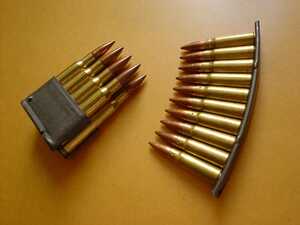
Bullet Clips — M1 Garand left, SKS Stripper right — Wikipedia
You will all wind up shining the shoes of the Germans!Balbo The Japanese army and the Italian Fascists were violent and dangerous to confront. Mussolini's massive ego precluded listening to advice. The wars would not have been possible if people had been free to question their leaders.
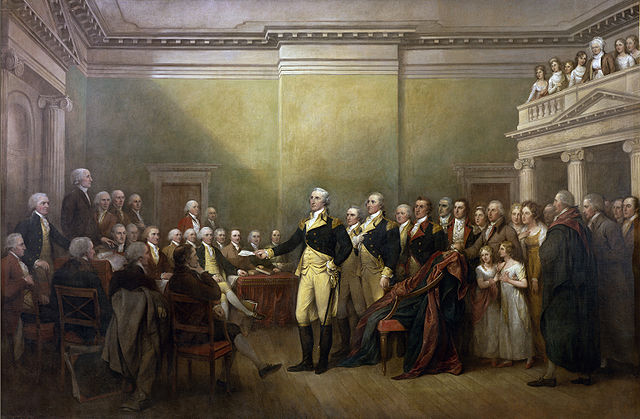
This John Trumbull painting shows General George Washington resigning as commander in chief of the army, at Annapolis on December 23, 1783. Later on, he resigned as president. Few revolutionary leaders resign. This picture was downloaded from Wikimedia Commons.
 Howard Gibson —
Email
hgibson@eol.ca
—
Last updated:
2025-11-21
Howard Gibson —
Email
hgibson@eol.ca
—
Last updated:
2025-11-21